Enter password to view case study
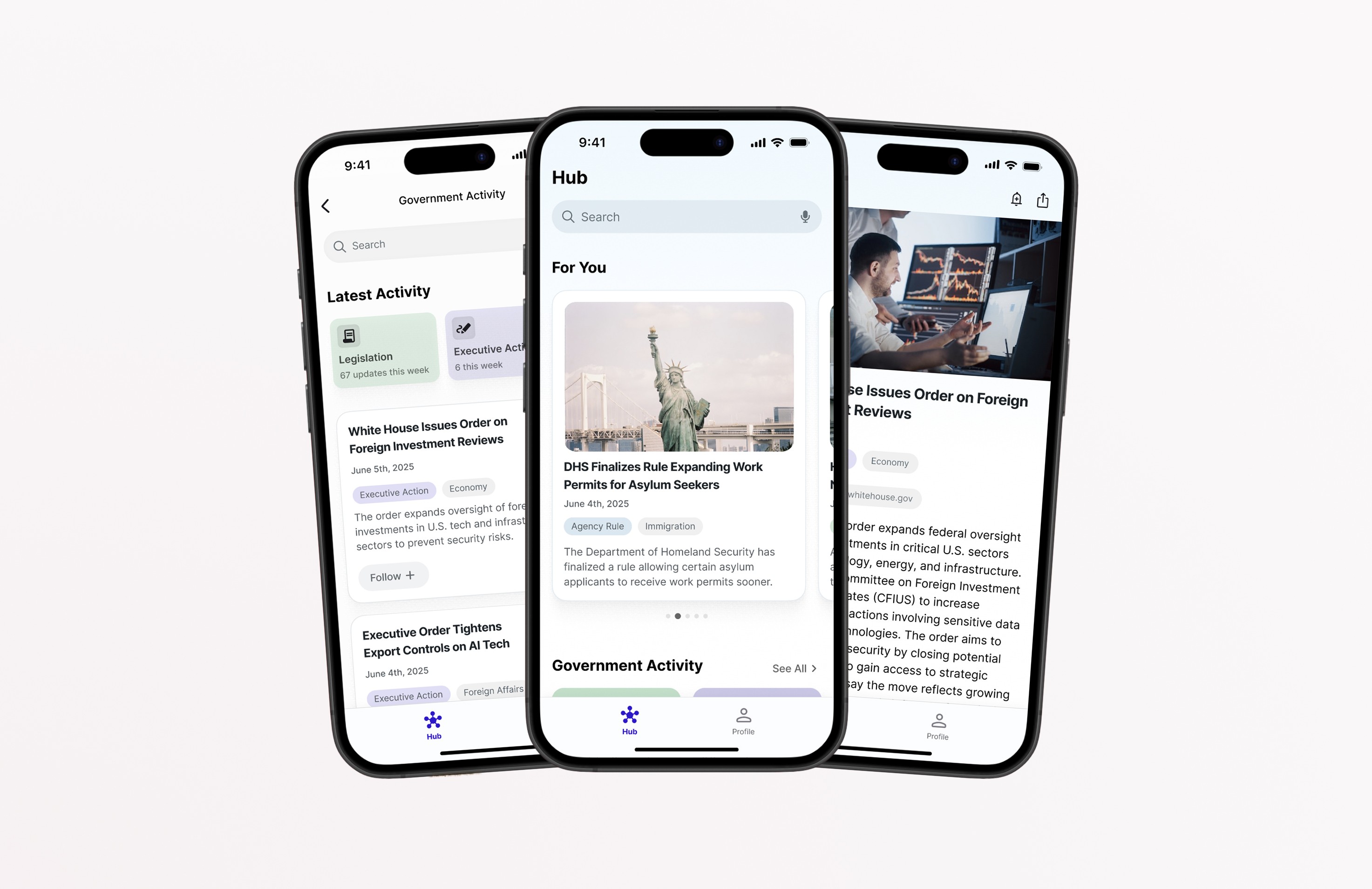
Rattle is a civic tech iOS app making government information accessible to everyday people. As a Product Designer, I narrowed a sprawling product vision down to one high-impact feature: an AI-powered activity feed surfacing federal government actions in plain English, personalized to each user's interests. The result was a complete, dev-ready prototype validated through user research with 100+ participants and usability testing.
Overview
Rattle is a civic tech mobile app built on a simple but ambitious premise: government information should be accessible to everyone, not just those with the time and patience to seek it out. As the sole product designer, I owned the end-to-end design process — from research and information architecture through a complete design system and dev-ready prototypes.
The design challenge here wasn't just visual. It was about taking a topic that is genuinely complicated, politically sensitive, and historically dry, and making it feel clear, trustworthy, and personally relevant to everyday people.
The Challenge
Government information is publicly available. But public availability and real accessibility are very different things. For most people, keeping up with what their government is actually doing means visiting multiple sources, parsing dense legal language, and piecing together a fragmented picture with no guarantee of completeness.
The result is that most people simply tune it out. Not because they don't care, but because the experience of staying informed is too burdensome to sustain.
Rattle's opportunity was to change that.
Research & Discovery
To validate our assumptions about the problem, I designed and distributed a survey via Qualtrics to just over 100 participants, asking what government information people are interested in and how they currently try to access it.
The findings confirmed our hypothesis and sharpened our focus.
What We Learned
Nothing felt personally relevant
Users weren't failing to find government information because it didn't exist. They were failing because it lived across too many sources, requiring significant effort to piece together a complete picture.
Information exists, but it's scattered
Slow loading caused abandonment across most platforms tested.
The language is a barrier
Content was written for policy professionals, not everyday residents. Without a background in law or government, most users couldn't meaningfully engage with what they found.
What This Meant for the Design
The solution wasn't to aggregate more information. It was to surface the right information, in plain language, ranked by what each user actually cares about. This finding became the foundation for every major design decision that followed.
Scoping: From Everything to One Thing
Early conversations with the founder surfaced a wide range of potential features: coverage of federal, state, and local government activity; politician profiles; bodies of government; social media feeds with claim analysis; petitions; elections. The ambition was clear, and so was the risk. Trying to build all of it would have meant building none of it well.
Two scoping decisions defined the project.
Cutting Scope to Federal Only
Starting with federal government activity gave us a focused, manageable content domain without sacrificing relevance. State and local coverage could follow once the core experience was validated.
Declining the Social Media Feature
Key Design Decision: The Hub
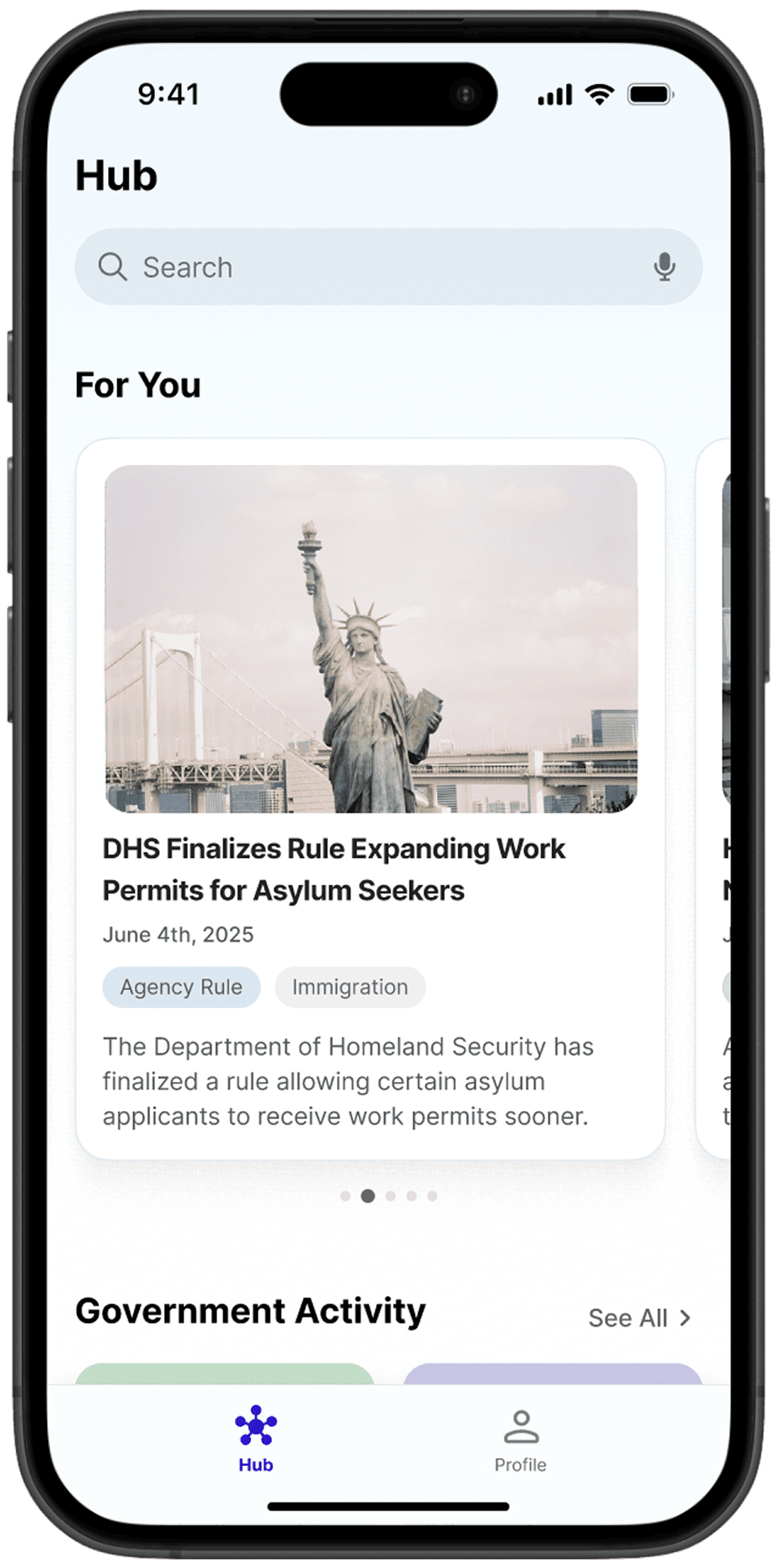
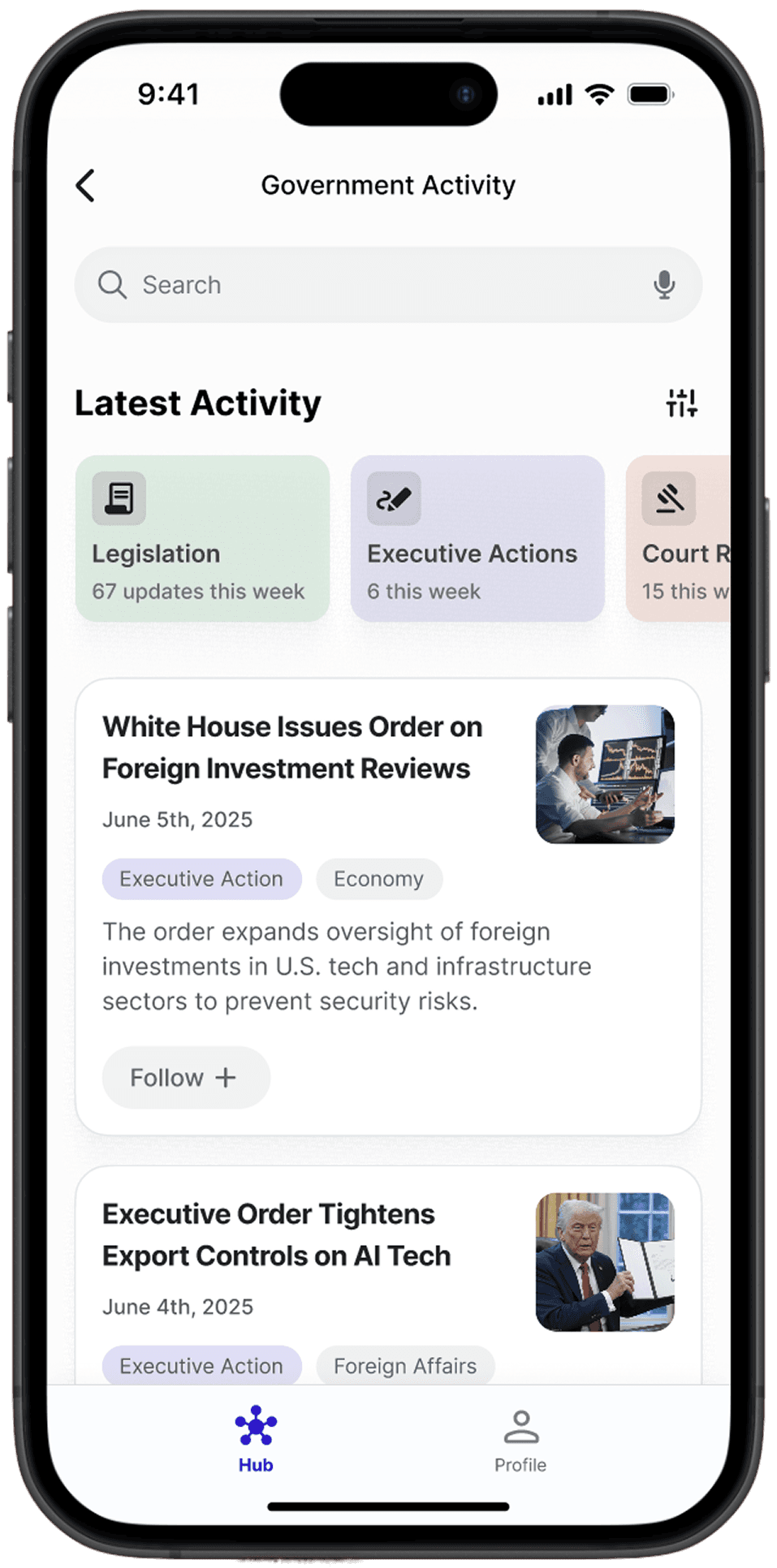
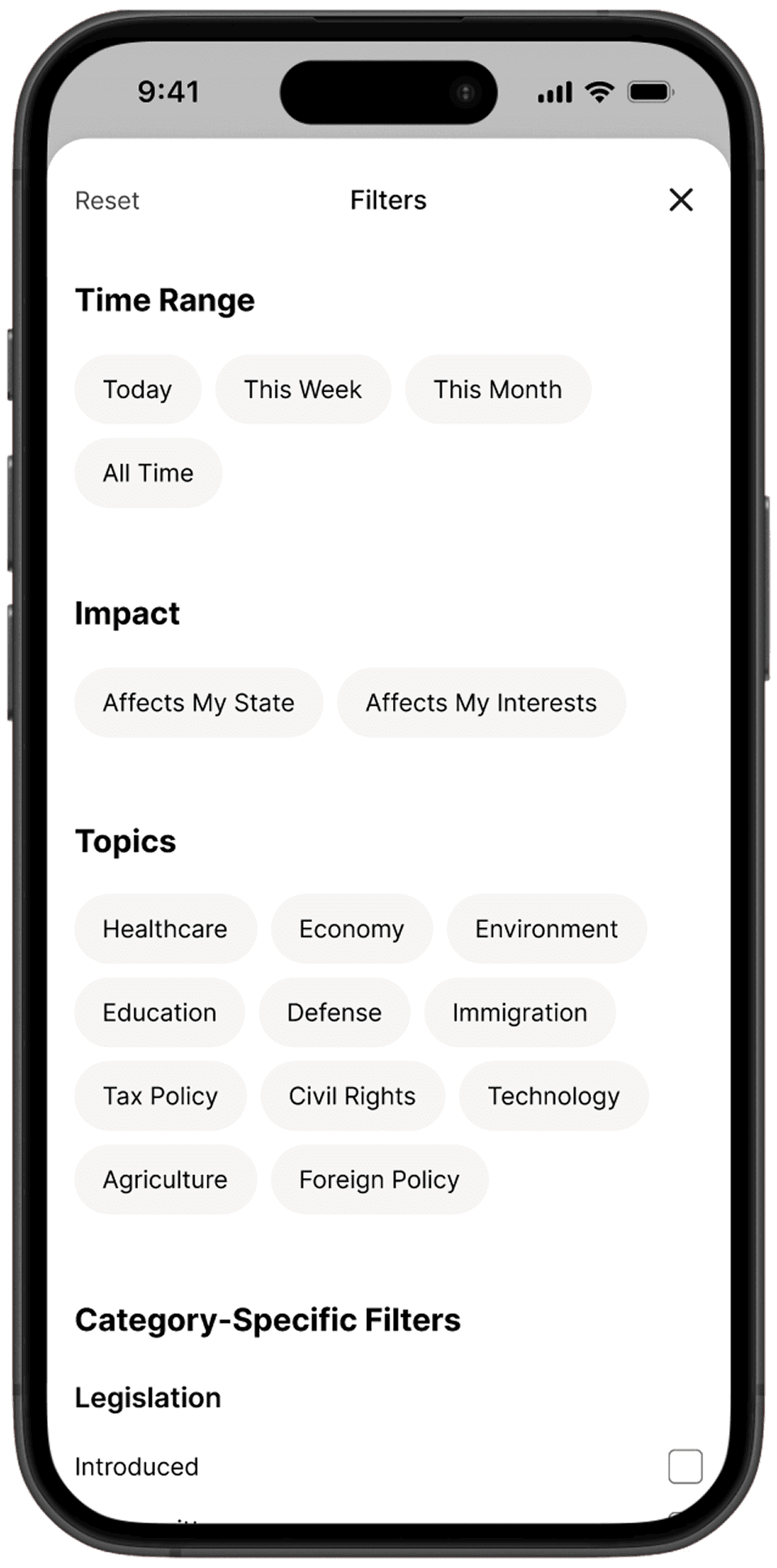
The Hub is the heart of the Rattle experience. It's a single, unified section that surfaces the most recent federal government activity across four content types: legislation, executive actions, court rulings, and agency decisions.
Three design principles shaped how the Hub works:
Plain English First
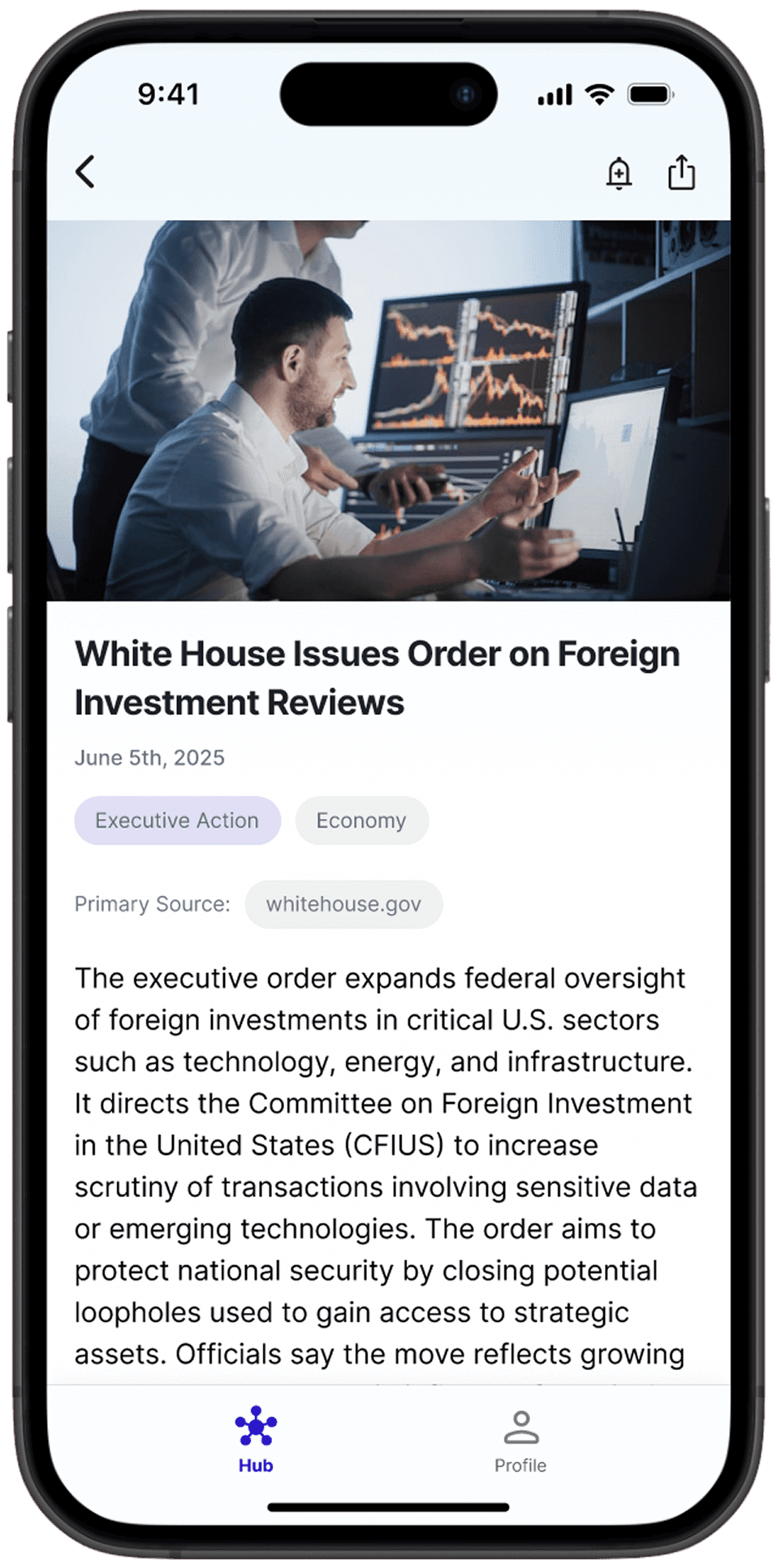
Every item in the Hub is summarized by AI in language that any resident can understand. No policy jargon, no assumed context. Primary sources are linked alongside each summary so users can go deeper if they want to, but they never have to.
Personalization Over Chronology
Simplicity as a Trust Signal
Information Architecture & Onboarding
Making the Hub feel personal from the first session required knowing something about the user before they got there. I designed a multi-step onboarding flow to establish user context upfront: topics they care about, areas of interest, and preferences that would shape what they saw in the Hub.
The IA was built around a single principle: surface what's relevant first, not what's most recent. A chronological firehose of government activity would have recreated the exact problem we were trying to solve. Relevance-first meant the experience felt manageable rather than overwhelming — even when the underlying content was genuinely complex.
Design System
Before designing a single screen, I built a design system in Figma. This was a deliberate upfront investment: establishing a consistent visual language, component library, and typography and color styles meant I could move faster through high-fidelity design and give the engineer a scalable foundation to build from.
The system kept visual standards consistent across the app as it grew, and reduced the ambiguity that typically slows down design-to-development handoff.
Usability Testing
Prototypes were shared with a small group of potential users during the design process. Feedback was positive, particularly around the clarity and simplicity of the experience. The response validated that the core design principle, hiding complexity without hiding information, was landing the way we intended.
Outcome
The project delivered a complete, dev-ready prototype covering the full Rattle experience, from onboarding through the Hub, validated through user feedback and ready for engineering handoff.
The product ultimately didn't launch due to business reasons on the founder's side. But the design work was complete, and what it demonstrated was the core thesis of the project: that a genuinely complicated, high-stakes topic could be made to feel simple, clear, and trustworthy through deliberate, user-centered design decisions.
That's what I'm most proud of here. Not any individual screen, but the fact that the complexity is invisible to the user.
Reflection
The hardest decisions in this project weren't about visuals, but rather scope and product direction. Pushing back on the social media feature, narrowing to federal activity only, and committing to a single high-impact feature instead of many half-formed ones, those decisions are what made the rest of the design work possible.
Civic and government tech is one of the most underleveraged spaces in product design. The gap between how important this information is and how inaccessible it currently feels is enormous. Rattle was an attempt to close that gap, and the work here is a foundation worth building on.
Thanks for reading! ✌️